
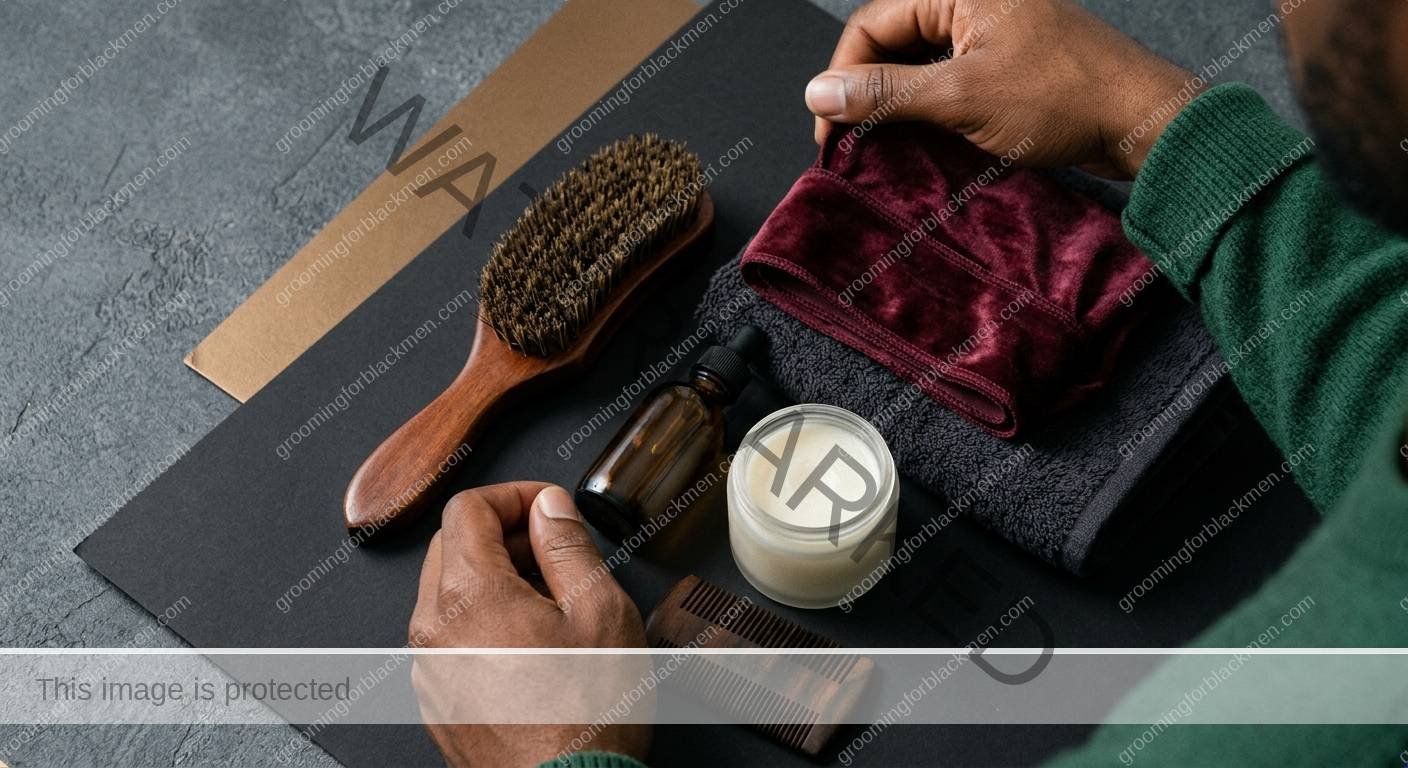
A brush that still feels comfortable, a clean durag that fits, and products you already use may be a better starting point than another wave bundle. Before spending, work out which part of your setup has actually stopped doing its job. A fading logo is different from snagging bristles. An almost-empty conditioner is different from a jar you bought because somebody else’s waves looked sharp.
This guide is for managing the cost of your 360-wave routine over time: what to keep, what to replace, what can wait, and how to leave room for refills and barber visits. It is not another complete starter-kit list or a promise about how quickly your pattern will develop. For other spending decisions, the budget grooming hub keeps the wider picture in view.
Start with your shelf, not a shopping cart

Put your wave tools and hair products together where you can see them. Include what is in your gym bag, the second durag in a drawer, and the conditioner you use on wash day. Write down the item, its condition, and the reason you reach for it. You are looking for gaps in a working routine, not trying to build a collection that looks complete in a photograph.
Describe the problem before naming a purchase. “My brush catches near the handle” is useful. “My waves need more” is not specific enough to spend against. Likewise, “I have no clean covering while this one dries” identifies a practical gap; “I need every type of cap” does not. A useful budget starts with that distinction.
| Item | Check before buying | Decision |
|---|---|---|
| Current brush | Does it snag, scratch, shed bristles, or feel uncomfortable at your current hair length? | Keep if comfortable and intact; replace a damaged tool rather than adding a duplicate. |
| Durag or other covering | Can it fit without pulling, and can you keep it clean? | Keep a comfortable one. Consider a spare only for a real laundry or travel gap. |
| Shampoo and conditioner | Are they usable, compatible with their instructions, and already part of a comfortable routine? | Plan the next refill before buying another finishing product. |
| Leave-in or styling product | Do you use it, and can you describe what it adds without repeating another product’s role? | Keep a useful product; defer a second jar bought for the same purpose. |
| Barber visit | What service do you actually want, and what is the quoted total? | Include it as a separate expense instead of pretending tools are the entire cost. |
If you are new to waves and do not yet know how you want to style them, use this related routine guide to work on the routine itself. Here, the decision is what deserves your next dollar. Buying another product cannot tell you whether the underlying issue is an unfamiliar brush path, an uncomfortable covering, or simply an expectation copied from someone else’s hair.
Give the next purchase one specific job

Separate an essential replacement from an optional experiment. A brush with damaged bristles, a covering that no longer fits comfortably, and an empty bottle are different decisions from trying a new scent or buying a coordinated set. You can enjoy an upgrade without calling it necessary. That honesty makes it easier to decide what fits this month’s budget.
Buy for the hair you have now
Do not choose a brush only because its label says hard, professional, or advanced. If your current brush feels rough, buying a firmer one is not a sensible default. Look at construction, grip, return conditions, and whether the tool feels comfortable for your present hair length. A barber familiar with your texture can help you assess a tool or haircut choice without turning the conversation into a full product purchase.
You do not need to earn a hairstyle through discomfort. The American Academy of Dermatology’s hair-damage guidance cautions against excessive brushing. This is general safety advice, not a medically established wave-training schedule. There is no brush-stroke quota in this guide, and more pressure is not the answer to a spending problem.
Keep basic care in the budget
When money is tight, a nearly empty wash-day product deserves a place in the calculation before a second finishing cream. The AAD’s Black-hair care guidance includes conditioning after washing. That supports keeping basic hair care funded; it does not establish that a particular wave-branded formula is required.
Follow each product’s instructions. A rinse-out conditioner and a leave-in are not interchangeable just because both use the word conditioner. Do not turn an existing product into an improvised treatment to avoid buying the right type, and do not discard a comfortable product merely because it was not marketed to wavers.
Make a comfortable fit non-negotiable
A covering that stays in place only when you tie it painfully tight is not a successful budget buy. The AAD explains that repeated pulling and rubbing can contribute to hair loss. Applied cautiously to a wave routine, that means avoiding tension rather than adding tighter layers to chase a finish. This is not evidence for a particular durag material, brand, or wear duration.
If your current covering is comfortable but you want a different color, put that in the optional column. If it pulls or rubs, stop using that fit and reassess it. Do not buy another layer to hold an uncomfortable one in place. A second covering can solve a laundry problem; it should not become an excuse for more pressure.
Separate the first purchase from the cost of keeping going

A starter total is only one number. Your actual plan also includes refills, replacing worn equipment, and the barber services you choose. Keep those expenses separate so that an occasional tool purchase does not hide the recurring cost. There is no universal amount a Black man must spend to maintain waves, and a price tag cannot promise a particular result.
Use three lines in a note: buy now, refill next, and optional later. Put only the item that solves today’s identified problem under buy now. Add products that are approaching empty under refill next. Colors, duplicate brushes, new scents, and products you are merely curious about belong under optional later until you decide otherwise.
| Hypothetical situation | Calculation | What it tells you |
|---|---|---|
| You have $25 available, a useful conditioner refill would cost $9, and a replacement brush would cost $11. | $25 – $9 – $11 = $5 remaining. | A $12 optional jar does not fit without changing the plan. |
| A $12 product lasts you three months. | $12 divided by 3 = $4 per month. | Its recurring cost differs from the amount paid at checkout. |
| A $20 brush remains usable for ten months. | $20 divided by 10 = $2 per month. | This is a retrospective cost, not a predicted lifespan. |
Substitute your own receipts and actual use. Prices, taxes, delivery charges, bottle sizes, and how long products last vary. Do not buy a larger container solely because its unit price is lower if you have not used the formula before. A cheaper price per ounce is not helpful if most of it stays unused.
Barber costs deserve the same clarity. Ask for the price of the service you want before the appointment and include any planned tip or travel cost in your own total. Decide whether the expense belongs this week or later. Do not turn a personal spending choice into a universal haircut timetable or a reason to accept a cut you did not want.
Compare categories without rebuilding the whole kit
GFBM may earn a small commission from qualifying purchases. These links are examples of product categories, not promises that one product will solve everything.
- wave brush for Black men: compare how the tool is made, whether its grip works for you, and the seller’s return conditions. A higher price is not proof that you need a harder brush.
- durag for 360 waves: compare fit, seams, care instructions, and the practical reason for replacing your current covering. Buy a spare for a genuine gap, not because more layers look more serious.
- light moisturizer for waves: check whether you want a leave-in conditioning product or a styling finish, then read its directions. The search label is a category starting point, not a verified product recommendation.
These are the existing affiliate search links, not a ranked list or a live price comparison. The products returned can change. Check the individual item, size, ingredients, seller, and instructions before buying; this guide has not tested the listings or established that one is appropriate for your scalp. You may also find that no purchase is needed.
Give yourself a stop condition before browsing. For example: “I am replacing the brush that snags, and I am not buying a second styling product today.” That sentence is more useful than browsing until the basket reaches an arbitrary budget cap. An unused allowance is not money you have to spend.
When the result changes, check the setup before the checkout
Different problems call for different decisions. Do not let every disappointing mirror check become a reason to buy a stronger product. Use the observations below to decide what to inspect, while keeping scalp symptoms separate from styling preferences.
| What you notice | What to check | What not to assume |
|---|---|---|
| Your brush starts catching. | Inspect it for trapped hair, damaged bristles, or a rough edge; follow its cleaning directions. | That you need to push harder or buy several brush grades. |
| A product leaves a finish you dislike. | Check how you used it against its directions and what else was layered with it. | That a second product on top will correct the first one. |
| Your covering slips. | Reconsider its fit and how it is worn. | That tighter knots or multiple layers are the next step. |
| The style looks different after a haircut. | Discuss the length and finish with your barber before changing the whole shelf. | That the old products have suddenly become useless. |
| You have persistent itching, sores, or new thinning. | Stop the irritating practice and seek appropriate clinical advice. | That buying oil or brushing through it is a diagnosis or treatment. |
Flakes alone do not identify their cause. Do not automatically label them buildup, then spend on several treatments or scrub harder. Similarly, a change in hair density is not a shopping category. The AAD advises dermatology assessment for changes in hair appearance or texture, including thinning. A clinician can investigate symptoms; a brush review cannot.
For an appearance-only experiment, write down what you changed and leave other comfortable steps alone. This is a way to keep purchases understandable, not a clinical test or a guaranteed method for producing waves. Stop a product or practice that clearly irritates you rather than continuing simply to finish what you paid for.
A spending check you can repeat without starting over

At the end of a normal week, look at the items you actually used. This seven-day check is an accounting exercise, not a wave-results deadline. Record purchases, what is getting low, and any equipment issue that interrupted your routine. A simple note is enough; you do not need a subscription, another app, or daily photographs to manage this budget.
- Used: list the brush, covering, wash products, and styling product you reached for.
- Problem: describe one specific inconvenience or source of discomfort, if there was one.
- Next expense: identify the first refill or genuine replacement you expect to need.
- Deferred: name the optional item you decided not to buy yet.
- Decision: keep the setup, change one item, or seek help for a scalp concern rather than shopping for it.
Nothing needs replacing merely because the week ended. If the brush is intact, the covering is comfortable, and the products still serve you, keep them. When another grooming expense competes for the same money, return to the budget grooming hub and decide across the whole budget rather than treating waves as a separate unlimited allowance.
Frequently Asked Questions
What should I buy first if I already own some wave products?
Start with the missing or failed item you can identify, not a predetermined bundle. An empty conditioner and a damaged brush are concrete needs. If your existing items are comfortable and usable, you may not need to buy anything. Write down the problem before comparing replacements.
Do I need soft, medium, and hard brushes to stay on budget?
Do not buy every grade to make the shelf look complete. Assess the brush you have against your current hair length and comfort. There is no universal brush collection prescribed here. If you are unsure about a tool or cut, ask your barber rather than assuming harder is better.
Is an expensive wave product worth the extra money?
Only you can decide whether its particular use justifies the cost in your routine. Compare the actual product and the amount you use, not prestige or someone else’s results. This guide has not established that cheap and expensive formulas are equivalent, or that a premium label produces better waves.
Should I keep a second durag?
A spare can be a practical choice if laundry, travel, or drying leaves you without a clean, comfortable covering. That is different from wearing multiple layers to increase pressure. You do not need a collection of colors to make the budget work, and an uncomfortable fit needs reassessment.
Can I cut costs by skipping washing or conditioning?
Do not finance optional styling purchases by abandoning basic care. Keep a comfortable cleansing and conditioning routine, following product directions and any clinical advice you have received. This article does not prescribe one wash frequency for every scalp. Adjusting care for symptoms is not the same as buying fewer products.
How quickly should a budget routine produce visible waves?
There is no promised timetable here. Hair, length, styling choices, and your starting point differ, and the sources used do not establish a universal wave deadline. Assess spending by whether purchases solve an identified need, not by a promise of a certain pattern by next week.
What if brushing or wearing a covering hurts?
Stop the uncomfortable practice rather than tightening the covering or increasing brushing to compensate. Reassess the fit and tool. Persistent symptoms, sores, or new thinning merit clinical advice. Spending more on styling products is not a substitute for finding out why your scalp is uncomfortable.
What to Do Next
Choose one item from your inventory and make one decision: keep it, replace it for a specific reason, or leave it off the shopping list. Put your next refill and barber expense beside that decision so the total reflects how you actually maintain your hair. The aim is a routine you can afford to continue, not a kit that wins the first-day photograph.
Use the main GFBM guide for this grooming lane for other spending choices. If your question extends beyond waves to general washing, products, and scalp-care spending, this related GFBM guide covers the wider hair-and-scalp budget. Neither next read requires buying something today.