

Beard Product Buildup for Black Men: Practical Grooming Guide
Beard care is an investment—one that pays off in confidence, presence, and self-respect. For Black men, whose beards are often coarse, curly, or tightly coiled, every step in your routine matters. You wash, condition, oil, brush, and shape. But even the most disciplined grooming can get derailed by a subtle enemy: beard product buildup. If your beard feels heavy, looks dull, or you’re battling flakes and irritation, buildup could be the root cause.
Beard product buildup happens when residue from oils, balms, butters, conditioners, and even hard water accumulates on your hair and skin. For Black men, whose beard hair is denser, drier, and more prone to tangling, buildup can sneak up fast. It’s not about using “too much” product—it’s about using the right products, in the right way, and making sure you’re actually removing what you don’t need.
Ignoring buildup doesn’t just affect how your beard looks. It can block moisture, trap dirt, and make common issues like beard itch, dandruff, and breakage worse. The solution isn’t to stop using products—your beard needs them. The key is to understand what causes buildup, how to prevent it, and how to reset your beard without stripping away what makes it strong.
This guide breaks down beard product buildup for Black men with practical, direct advice. You’ll learn why it matters, what usually goes wrong, how to fix it, and how to keep your beard at its best—without hype, stereotypes, or empty promises. If you’re ready to level up your grooming for Black men, you’re in the right place. For more on beard care fundamentals, check out our Beard Care & Beard Growth pillar.
Real-Life Beard Routine Scenarios for Beard Product Buildup for Black Men
A strong beard routine has to work outside of perfect bathroom-counter conditions. It has to work when you are rushing before work, when your beard feels dry after a long day, when the weather changes, and when your barber has shaped the line cleaner than you expected. For Black men, that routine also has to respect dense curls, coarse strands, sensitive skin under the beard, and the fact that product buildup can hide until the beard starts itching, flaking, or looking dull.
Start by reading the beard before adding more product. If the beard feels rough but the skin underneath is calm, you may need better conditioning, a lighter oil, or more consistent brushing. If the skin feels tight, itchy, or irritated, the answer is usually not more shine. It may be a gentler wash schedule, a cleaner rinse, a lighter hand with balm, or a pause from heavy fragrance. The discipline is in changing one variable at a time so you can tell what actually helped.
For a short beard, keep the routine direct: cleanse when needed, moisturize the skin beneath, use a small amount of oil or balm, and brush enough to distribute product without scraping the skin. For a fuller beard, section the work. Apply product from the skin outward, then shape the hair so the surface looks neat without leaving the roots dry. The fuller the beard gets, the more important it becomes to separate grooming from coating. A beard can look shiny and still be dehydrated underneath.
Budget matters too. You do not need a crowded shelf to manage beard product buildup for black men. A dependable wash, one conditioning product, and one tool you actually use will outperform five products that fight each other. If money is tight, upgrade the item that touches your skin or beard most often. If time is tight, simplify the routine instead of skipping care entirely. Consistency beats a complicated plan that only happens twice a month.
How to Audit Your Beard Without Overreacting
Give any beard change enough time to show a pattern. One dry morning does not mean the routine failed. One good beard day does not mean every product is perfect. Track how your beard feels after washing, how the skin underneath feels at night, whether flakes return quickly, and whether the beard holds shape without becoming stiff. Those signals tell you more than packaging claims or social media routines built for a different texture.
If irritation shows up, simplify. Remove the newest product first, reduce fragrance, avoid scratching, and return to a basic cleanse-and-moisturize rhythm. If flakes, soreness, bleeding, swelling, or persistent itching keep coming back, that is a reason to get professional help rather than forcing stronger products into the routine. Grooming should make you look more put together, but it should also leave your skin calmer over time.
Real-Life Beard Routine Scenarios for Beard Product Buildup for Black Men
A strong beard routine has to work outside of perfect bathroom-counter conditions. It has to work when you are rushing before work, when your beard feels dry after a long day, when the weather changes, and when your barber has shaped the line cleaner than you expected. For Black men, that routine also has to respect dense curls, coarse strands, sensitive skin under the beard, and the fact that product buildup can hide until the beard starts itching, flaking, or looking dull.
Start by reading the beard before adding more product. If the beard feels rough but the skin underneath is calm, you may need better conditioning, a lighter oil, or more consistent brushing. If the skin feels tight, itchy, or irritated, the answer is usually not more shine. It may be a gentler wash schedule, a cleaner rinse, a lighter hand with balm, or a pause from heavy fragrance. The discipline is in changing one variable at a time so you can tell what actually helped.
For a short beard, keep the routine direct: cleanse when needed, moisturize the skin beneath, use a small amount of oil or balm, and brush enough to distribute product without scraping the skin. For a fuller beard, section the work. Apply product from the skin outward, then shape the hair so the surface looks neat without leaving the roots dry. The fuller the beard gets, the more important it becomes to separate grooming from coating. A beard can look shiny and still be dehydrated underneath.
Budget matters too. You do not need a crowded shelf to manage beard product buildup for black men. A dependable wash, one conditioning product, and one tool you actually use will outperform five products that fight each other. If money is tight, upgrade the item that touches your skin or beard most often. If time is tight, simplify the routine instead of skipping care entirely. Consistency beats a complicated plan that only happens twice a month.
How to Audit Your Beard Without Overreacting
Give any beard change enough time to show a pattern. One dry morning does not mean the routine failed. One good beard day does not mean every product is perfect. Track how your beard feels after washing, how the skin underneath feels at night, whether flakes return quickly, and whether the beard holds shape without becoming stiff. Those signals tell you more than packaging claims or social media routines built for a different texture.
If irritation shows up, simplify. Remove the newest product first, reduce fragrance, avoid scratching, and return to a basic cleanse-and-moisturize rhythm. If flakes, soreness, bleeding, swelling, or persistent itching keep coming back, that is a reason to get professional help rather than forcing stronger products into the routine. Grooming should make you look more put together, but it should also leave your skin calmer over time.
Real-Life Beard Routine Scenarios for Beard Product Buildup for Black Men
A strong beard routine has to work outside of perfect bathroom-counter conditions. It has to work when you are rushing before work, when your beard feels dry after a long day, when the weather changes, and when your barber has shaped the line cleaner than you expected. For Black men, that routine also has to respect dense curls, coarse strands, sensitive skin under the beard, and the fact that product buildup can hide until the beard starts itching, flaking, or looking dull.
Start by reading the beard before adding more product. If the beard feels rough but the skin underneath is calm, you may need better conditioning, a lighter oil, or more consistent brushing. If the skin feels tight, itchy, or irritated, the answer is usually not more shine. It may be a gentler wash schedule, a cleaner rinse, a lighter hand with balm, or a pause from heavy fragrance. The discipline is in changing one variable at a time so you can tell what actually helped.
For a short beard, keep the routine direct: cleanse when needed, moisturize the skin beneath, use a small amount of oil or balm, and brush enough to distribute product without scraping the skin. For a fuller beard, section the work. Apply product from the skin outward, then shape the hair so the surface looks neat without leaving the roots dry. The fuller the beard gets, the more important it becomes to separate grooming from coating. A beard can look shiny and still be dehydrated underneath.
Budget matters too. You do not need a crowded shelf to manage beard product buildup for black men. A dependable wash, one conditioning product, and one tool you actually use will outperform five products that fight each other. If money is tight, upgrade the item that touches your skin or beard most often. If time is tight, simplify the routine instead of skipping care entirely. Consistency beats a complicated plan that only happens twice a month.
How to Audit Your Beard Without Overreacting
Give any beard change enough time to show a pattern. One dry morning does not mean the routine failed. One good beard day does not mean every product is perfect. Track how your beard feels after washing, how the skin underneath feels at night, whether flakes return quickly, and whether the beard holds shape without becoming stiff. Those signals tell you more than packaging claims or social media routines built for a different texture.
If irritation shows up, simplify. Remove the newest product first, reduce fragrance, avoid scratching, and return to a basic cleanse-and-moisturize rhythm. If flakes, soreness, bleeding, swelling, or persistent itching keep coming back, that is a reason to get professional help rather than forcing stronger products into the routine. Grooming should make you look more put together, but it should also leave your skin calmer over time.
Why Beard Product Buildup Matters for Black Men

Beard grooming for Black men isn’t just about looking sharp—it’s about respecting the unique needs of your hair and skin. Black men’s beards are typically more curly, coarse, and prone to dryness. This means:
- Products cling harder: Oils, butters, and balms can get trapped in tight curls and dense growth, making buildup more likely.
- Moisture balance is critical: Your beard needs hydration, but too much residue blocks water and nutrients from getting in.
- Skin health is at stake: Buildup can clog pores, leading to irritation, bumps, or beard dandruff. If you’re dealing with flakes, see our beard dandruff guide.
- Appearance suffers: Buildup makes beards look dull, feel greasy, and lose their natural shape. It can also make styling harder and reduce the effectiveness of your favorite products.
For Black men, a disciplined approach to beard care isn’t optional—it’s essential. The goal is a beard that’s clean, soft, and strong, without sacrificing the moisture and protection your hair needs. That balance starts with understanding and controlling product buildup.
How Buildup Specifically Impacts Black Men’s Beards
Coarse and curly beard hair has a unique structure. The cuticle layers are more raised, which means moisture escapes faster and products can sit on the surface instead of absorbing. When product sits on the hair and skin, it can:
- Block new moisture from penetrating, leading to dryness beneath the surface even if the beard feels oily.
- Trap dead skin cells, causing flakes or “beardruff.”
- Encourage ingrown hairs by clogging follicles, especially if you’re prone to razor bumps or pseudofolliculitis barbae.
- Make your beard feel stiff, sticky, or hard to style.
Understanding these risks is the first step to building a routine that works for you—not against you.
What Usually Goes Wrong

Even with the best intentions, it’s easy to fall into habits that lead to beard product buildup. Here’s where most routines break down:
- Over-layering products: Applying oil, balm, and butter without clarifying washes in between can create layers of residue.
- Using heavy products daily: Some butters and balms are best for occasional deep conditioning, not everyday use.
- Skipping proper cleansing: Rinsing with water or using regular shampoo isn’t enough. Most shampoos are too harsh or not designed for facial hair.
- Hard water: Minerals in hard water bind to products and beard hair, making it harder to rinse clean.
- Poor brushing/combing technique: Without regular detangling, product and dead skin get trapped deep in the beard.
- Not adjusting for climate or activity: Sweat, pollution, and weather can change how much product your beard needs and how often you should cleanse.
These missteps don’t mean you’re doing it “wrong”—they’re common, especially if you’re learning by trial and error. The good news: a few disciplined changes can reset your beard and keep buildup in check.
Real-Life Scenarios: How Buildup Sneaks In
- The “Overachiever”: You want the softest, most defined beard, so you layer oil, balm, and butter every day. By midweek, your beard feels sticky and looks dull. Solution: Scale back. Use oil daily, but reserve balm or butter for when your beard feels dry or needs extra hold.
- The “Quick Rinse”: You rinse your beard with water after workouts but skip a proper cleanser. Sweat, oil, and product build up, leading to itch and flakes. Solution: Use a gentle beard wash after heavy sweating or exposure to dirt and pollution.
- The “Hard Water Trap”: You wash your beard regularly, but minerals in your water leave residue behind. Your beard never feels truly clean. Solution: Install a shower filter or do a weekly rinse with distilled water.
- The “Neglected Tools”: You use the same brush or comb for months without cleaning it. Old product and dead skin get re-deposited into your beard. Solution: Clean your beard tools weekly with warm water and a gentle soap.
What to Do Instead: A Practical Routine for Black Men

As an affiliate site, GFBM may earn from qualifying purchases through product links.
Managing beard product buildup for Black men is about consistency, not extremes. Here’s a practical, premium routine that respects your time, hair, and skin:
- Clarify regularly: Use a clarifying beard wash once a week or as needed to remove heavy buildup. Look for sulfate-free formulas designed for coarse or curly beards. GFBM may earn a small commission from qualifying purchases, but product examples are included to clarify criteria, not to promise results.
- Daily gentle cleanse: On non-clarifying days, rinse with lukewarm water or use a mild beard cleanser. Avoid harsh soaps or scalp shampoos.
- Smart product layering: Start with a lightweight beard oil after washing. Use balm or butter only when needed for extra moisture or hold. Don’t layer all three daily unless your beard is extremely dry.
- Brush and comb daily: Use a beard brush for Black men to distribute oils and remove debris. Follow with a beard comb for coarse beard to detangle and lift buildup from the roots.
- Adjust for your environment: If you sweat, work outdoors, or live in a polluted area, cleanse more often and use lighter products.
- Watch for signs of buildup: If your beard feels heavy, looks dull, or you notice flakes, it’s time to clarify and scale back on heavy products for a few days.
Step-by-Step Routine Logic
- Morning: Splash your beard with lukewarm water. Pat dry. Apply a few drops of lightweight oil, working from skin to tips. Brush through to distribute.
- After workouts or exposure to dirt: Rinse with water or use a gentle beard cleanser. Pat dry and reapply oil if needed.
- Evening (if needed): If your beard feels dry, apply a small amount of balm or butter. Comb through to detangle and soften.
- Weekly: Use a clarifying beard wash. Follow with oil and, if needed, a light butter to restore moisture.
For more on building a solid routine, see our beginner beard routine. If you’re unsure about which products to use, our best beard oils and oil vs balm vs butter guide break down the differences for Black men’s beards.
Routine Adjustments for Real Life
- Traveling? Bring a travel-size clarifying wash and a small bottle of oil. Hard water in hotels can increase buildup risk.
- Growing your beard out? As your beard gets longer, buildup risk increases. Clarify more often and use a wide-tooth comb to reach the roots.
- Hot, humid days? Use less butter or balm. Stick to lightweight oil and rinse more often to prevent sweat and product from mixing into residue.
Product and Tool Criteria for Managing Buildup
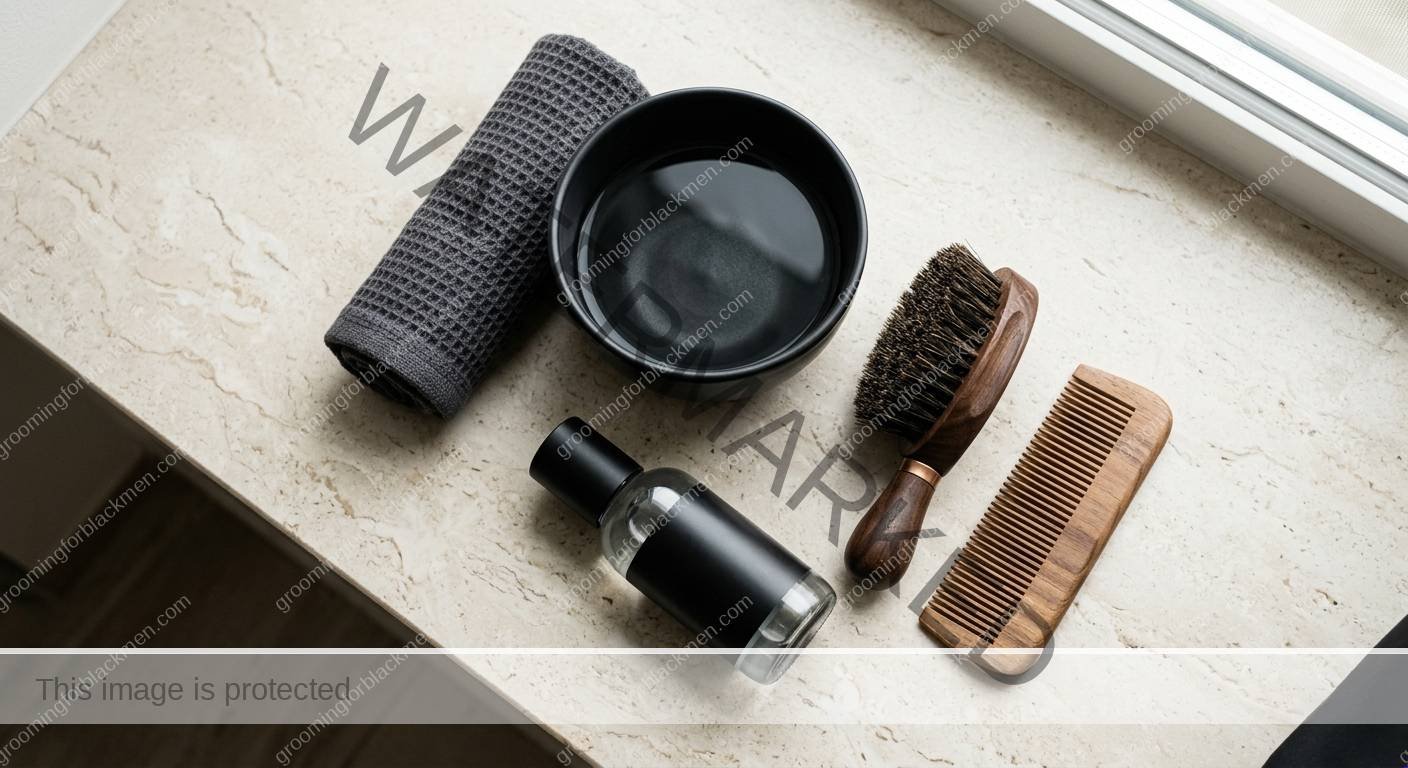
Not all beard products and tools are created equal. Here’s what to look for if you want to avoid buildup and keep your beard healthy:
- Clarifying Beard Wash: Choose sulfate-free, pH-balanced washes made for facial hair. Avoid harsh detergents that strip natural oils. A good clarifier should remove residue without leaving your beard dry or brittle.
- Beard Oils: Lightweight oils (like argan or jojoba) absorb quickly and are less likely to build up than heavy, sticky blends. Avoid mineral oil or petroleum-based ingredients.
- Beard Balms & Butters: Use sparingly. Look for natural butters (shea, mango, cocoa) and waxes. If a product feels sticky or greasy hours after application, use less or switch to a lighter formula.
- Brushes: A boar bristle beard brush helps distribute oils and remove buildup. Avoid plastic bristles, which can snag and break curly hair.
- Combs: A wide-tooth beard comb for coarse beards detangles without pulling. Wood or horn combs create less static and help lift residue from the roots.
- Water Quality: If you have hard water, consider a shower filter or rinsing with distilled water weekly to reduce mineral buildup.
For more on selecting the best tools, see our guide to the best beard brush and comb for Black men.
Decision Criteria: How to Choose What’s Right for You
- Ingredients: Look for short, natural ingredient lists. Avoid products with alcohol, parabens, or synthetic fragrances if you’re prone to irritation.
- Texture: Oils should feel light and absorb quickly. Balms and butters should melt into your beard, not sit on top.
- Fragrance: Subtle, natural scents are less likely to cause irritation or clash with your cologne.
- Packaging: Dark glass bottles protect oils from light and keep them fresh longer.
- Community Recommendations: Check reviews from other Black men with similar beard types. What works for straight hair may not work for coarse, curly beards.
Tool Maintenance: Don’t Overlook This Step
Clean your beard brush and comb weekly. Use warm water and a gentle soap. Let them air dry completely before the next use. Dirty tools can reintroduce old product and bacteria, sabotaging your routine.
Troubleshooting and When to Get Help

Most beard product buildup can be managed at home with the right routine. But sometimes, you’ll need to troubleshoot or get professional advice:
- If you notice: Persistent flakes, redness, swelling, pain, or pus—see a dermatologist or qualified clinician. These could be signs of infection or another skin condition, not just buildup.
- If your beard feels dry after clarifying: Follow up with a lightweight oil and use balm or butter only as needed. Avoid clarifying more than once a week unless advised by a professional.
- If you have severe tangling: Detangle gently with a wide-tooth comb after applying a little oil. Never yank or rip through knots.
- If you’re still struggling with itch or flakes: Check out our beard itch guide and beard dandruff guide for more targeted troubleshooting.
Never dig at ingrown hairs, use undiluted essential oils, or scrub aggressively. These can make irritation and buildup worse. If in doubt, a professional can help you reset your routine safely.
Common Troubleshooting Scenarios
- Beard still feels greasy after washing: You may need a stronger clarifying wash or to rinse longer. Double-cleanse if needed, but don’t overdo it—balance is key.
- Beard feels dry and brittle: Scale back on clarifying. Add a deep conditioning treatment once a week and use a humidifier if your home is dry.
- Ingrown hairs or bumps: Make sure you’re not clogging pores with heavy products. Cleanse thoroughly and use a soft brush to exfoliate gently.
- Persistent flakes: Try a beard-specific dandruff treatment. See our beard dandruff guide for more.
Frequently Asked Questions
How do I know if I have beard product buildup?
Common signs include a heavy, greasy, or sticky feeling in your beard, dull appearance, persistent flakes, itchiness, or difficulty absorbing new products. If your beard feels weighed down or looks less vibrant, buildup is likely.
How often should Black men clarify their beards?
Most Black men benefit from a clarifying beard wash once a week. If you use heavy products daily, sweat a lot, or live in a humid or polluted area, you may need to clarify more often. Always follow with a lightweight oil to restore moisture.
Can I use regular shampoo on my beard?
It’s best to avoid regular scalp shampoos. They’re often too harsh for facial hair and can strip away necessary oils, making dryness and tangling worse. Use a beard-specific cleanser or clarifying wash designed for coarse, curly hair.
What’s the best way to apply beard oil without causing buildup?
Apply a few drops of lightweight beard oil to damp, clean hair after washing. Massage it in with your fingertips, then use a beard brush to distribute evenly. Avoid layering oil on top of heavy balm or butter unless your beard is extremely dry.
Should I stop using beard balm or butter if I notice buildup?
No need to quit entirely. Instead, reduce how often you use heavy products and clarify your beard to remove existing buildup. Use balm or butter only when your beard feels dry or needs extra hold, not as a daily habit unless necessary.
How can I prevent beard product buildup if I have hard water?
Install a shower filter to reduce mineral content, or rinse your beard with distilled water once a week. Clarifying washes also help remove mineral and product residue that hard water leaves behind.
When should I see a dermatologist for beard issues?
If you have pain, infection, spreading redness, scarring, or persistent irritation that doesn’t respond to routine changes, see a dermatologist or qualified clinician. These could be signs of a medical condition, not just buildup.
What to Do Next
Beard product buildup for Black men is a manageable challenge with the right approach. Start by clarifying your beard, adjusting your product routine, and investing in quality tools. Stay disciplined—consistency is more important than chasing miracle fixes. If you’re new to beard care, review our beginner beard care routine. For persistent flakes or irritation, check out our beard dandruff guide.
For more advanced tips, see our guides on how to shape your beard and patchy beard fixes. Your beard is an investment—respect it, keep it clean, and it will serve you well.