You can give a patchy beard a considered shape without pretending every gap is about to fill in. The useful question is not whether your beard matches somebody else’s. It is which outline works with the hair you have, feels comfortable, and still looks like a choice when you leave the barber’s chair.
That matters when your chin looks substantial but your cheeks are lighter, one side connects differently, or a full-beard reference picture never translates to your face. For Black men, there is no single curl pattern, density, or preferred finish that a good style must follow. You are allowed to want definition without treating your natural growth as a failure.
This guide is the practical styling step: compare a few shapes, explain your boundaries to a barber, and keep the result manageable between appointments. It is not a growth challenge. A neater outline is a styling result, not proof that a brush, oil, or trim produced new hair.
Our Beard Care guide covers the wider routine. Here, start with one manageable decision: what would make your current beard easier to wear tomorrow? You do not need to buy anything before answering that.
The quick answer: choose the outline before chasing coverage
For an established sparse pattern, compare three possibilities: an evenly short beard, a shape centered on your strongest existing growth, or a longer arrangement that you genuinely like maintaining. None is automatically the right answer. Start with the amount of daily work and skin contact you are willing to accept.
The American Academy of Dermatology includes adapting your beard style to sparse growth among its appearance-focused suggestions. That is different from promising regrowth. The choices below turn that distinction into a barber conversation, not a prescription for a particular face.
Read the shape you have, without inspecting every hair

Before deciding what to remove, notice what you want to keep. Perhaps you like the chin length, the curve of your mustache, or the way your beard frames your face from the side. Starting there gives the appointment a purpose beyond making a bare area less noticeable.
Look at the whole beard in ordinary light, then check the left and right profiles. A close-up can help explain a specific request, but it should not become your only view. You are selecting an outline for a face, not correcting a diagram one square at a time.
Describe the pattern in plain terms
Use descriptions such as “lighter growth high on the cheeks,” “a gap beside the mustache,” or “one side looks fuller when I turn.” Those phrases help a barber understand what you mean without guessing a cause. Keep medical explanations out of the style brief unless a clinician has given you one.
A useful note has three parts: the area you are discussing, the shape you want to preserve, and the handling you dislike. For example: “The upper cheeks are lighter. Keep the chin shape. I do not want a close razor finish along those cheeks.” That is more actionable than asking someone to fix everything.
Choose a realistic reference
Use a reference for one feature, not an entire identity. You might like the width of a mustache or the shorter sides in a photograph. Tell the barber which detail interests you and ask whether your existing growth supports a similar outline. A photograph cannot promise the same density, texture, or maintenance needs.
Bring a recent picture of your own beard when you liked it, if you have one. It may show a workable starting point more clearly than a polished campaign image. You can say, “Keep this amount through the chin, but make the sides less bulky,” without asking for a different person’s beard.
Separate an established pattern from a new change
This styling discussion assumes you are working with a familiar growth pattern. A new bare area, noticeable shedding, pain, or continuing skin trouble belongs in a different conversation. Do not use a style appointment to explain away a change you do not understand. The professional-care section below explains that boundary.
You do not need to solve the cause of your beard distribution to express a style preference. Equally, being comfortable with a sparse beard does not mean ignoring a new concern. Those two decisions can stay separate.
Compare three directions, not a catalogue of perfect beards
A short list makes the decision easier to discuss. These are optional design directions rather than rules about what Black men should wear. You can prefer a sparse full outline, a compact shape, or very little facial hair. The point is to choose deliberately rather than keep trimming toward a result you never defined.
Option one: keep the whole outline shorter
This may appeal when you want a simple shape and do not enjoy arranging longer sections. Ask the barber to show what a shorter overall look would retain before reducing the length. “Shorter” is not enough detail: agree on the areas that should still look substantial and the amount you are comfortable losing.
Do not assume an evenly short look requires a skin-close finish. The cutting method and your preferred length are separate decisions. Tell the barber about previous discomfort and ask for an approach you can maintain comfortably. If the proposed finish depends on a technique you do not want, choose another version.
The trade-off is personal. You may like a compact outline but miss the chin length that made the beard feel like yours. Ask whether the first adjustment can preserve that feature. You do not have to remove everything just because the cheeks are less dense.
Option two: build around the growth you like most
You might prefer a mustache-and-chin combination, a compact goatee, or another shape that does not ask the cheeks to connect. Treat the names as conversation starters. Agree on the actual boundaries: where the sides end, how much width stays at the chin, and whether the mustache remains separate.
Consider the daily work before choosing. A small, precise outline can still demand attention if you want its edges freshly defined every morning. Ask what it looks like between appointments, not only immediately after detailing. A style that leaves you constantly correcting its borders may not be your simplest option.
There is no requirement to hide the transition between dense and sparse areas. A disconnected shape can be an intentional preference rather than a compromise waiting for permission to become a full beard.
Option three: keep more length, with an honest maintenance budget
If you like length, ask how the existing hair can be arranged without a forced sweep or a finish you dislike. Be clear about what you will actually do at home. A shape that requires careful repositioning whenever you touch your face may be less useful than a slightly more open outline.
Ask to see the beard in its usual finish before making the final decision. If you normally wear it lightly conditioned, a heavily styled reveal may not tell you how the cut will feel on an ordinary day. You can appreciate the barber’s work and still request a simpler finish.
Use one tie-breaker
When two directions appeal, choose the one that fits the next few weeks of your life. Think about time, cost, an upcoming appointment, or whether you want to preserve length. This is a choice you can revisit, not a verdict on how your beard should look forever.
Make the barber brief specific before the tools come out

A useful consultation includes what not to change. If you have spent time growing the chin, say so before the first pass. If a previous cheek line felt too high or too sharp for your taste, point to the area and describe the difference you want.
You do not need technical vocabulary to be precise. Bring a short note, use a mirror, and ask the barber to repeat the main plan back. Agreement about the result matters more than whether you know the name of every tool.
Try this four-part brief
- Keep: name the feature you want retained, such as chin length, mustache width, or a softer cheek outline.
- Change: identify one issue, such as sides that look bulkier than you prefer or a boundary that is difficult to follow at home.
- Avoid: explain unwanted skin-close work, a particular product, or a finish that previously felt uncomfortable.
- Maintain: describe the tools, time, and appointment frequency you can realistically manage.
For example: “Keep the chin length and mustache. Reduce the width at the sides, but do not take the cheek line higher. I want a finish I can arrange with my usual comb. Please show me the boundary before defining it.” Adapt the words to your beard rather than reading them as a universal cutting plan.
Agree on the stopping point
Ask to review the first broad adjustment before additional shortening or close detailing. A pause gives you a chance to check the overall shape while options remain. It is easier to request a little more refinement than to restore length removed beyond what you intended.
If you are uncertain, say that. “I am not ready to reduce this section further” is a complete instruction. A good consultation leaves room for your preference, including an outline that is less symmetrical or less sharply edged than the barber’s first suggestion.
Ask for the home version of the finish
Before leaving, ask what the barber did that you would need to repeat. Was the shape mainly the cut, or did the final arrangement depend on a product and several minutes of styling? Which areas should you leave alone until the next appointment? Those answers help prevent unnecessary daily corrections.
If a guard was used, record the actual tool, attachment, and method rather than a number alone. Do not treat that note as a license to copy an unfamiliar technique. Its purpose is to support a future conversation and help you understand the result you approved.
Maintain the chosen shape without trimming away the plan

The appointment establishes a shape. Your home routine should support that shape, not restart the design every morning. Decide which small tasks you understand and which you will leave for a barber. Doing less can be a sensible boundary when you are learning a new outline.
Keep care separate from coverage
The AAD’s healthy-beard guidance emphasizes gentle cleansing, care suited to the skin beneath the beard, and grooming. It distinguishes options for acne-prone, dry, and sensitive skin rather than requiring every reader to use oil. Those basics concern comfort and handling, not a promise to fill a gap.
Keep using a comfortable routine unless there is a reason to change it. A haircut does not automatically call for a new cleanser, conditioner, brush, and styling product. If your skin is uncomfortable, pause the cosmetic experiment instead of treating more product as the next compulsory step.
Arrange once, then assess the whole outline
Use your familiar grooming method to put the beard into the position you usually wear. Look from the front and both sides before deciding that anything needs cutting. Do not keep handling a small area until its appearance becomes the only thing you can see.
If you need to pull hair across a gap and keep repositioning it, consider whether you like that level of upkeep. There is no rule against a styled arrangement. The question is whether it stays acceptable to you during normal movement, conversation, and the rest of your day.
Do not chase the two sides into a smaller beard
One side may look different even after the same broad adjustment. Repeatedly shortening the fuller-looking side can move you away from the length you wanted to keep. Compare the overall outline, not just the densest point on each cheek.
Before correcting something, ask whether it is an unwanted edge, a section sitting differently, or simply the pattern you agreed to work with. If you cannot tell, leave it for your next consultation. Uncertainty is a reason to stop cutting, not to make another exploratory pass.
Keep a maintenance note that is worth reading
Record three observations after an ordinary day: what stayed arranged, what took more effort than expected, and what you want adjusted next time. “The chin length works; the right side needs too much repositioning” tells the barber more than “it got patchy again.”
Photographs can help document the shape, but they do not diagnose a change in growth. If you use them, try a similar angle and ordinary lighting. Keep private photos somewhere you control; a public progress diary is not required to make a useful grooming decision.
Choose tools for control, not for a growth promise
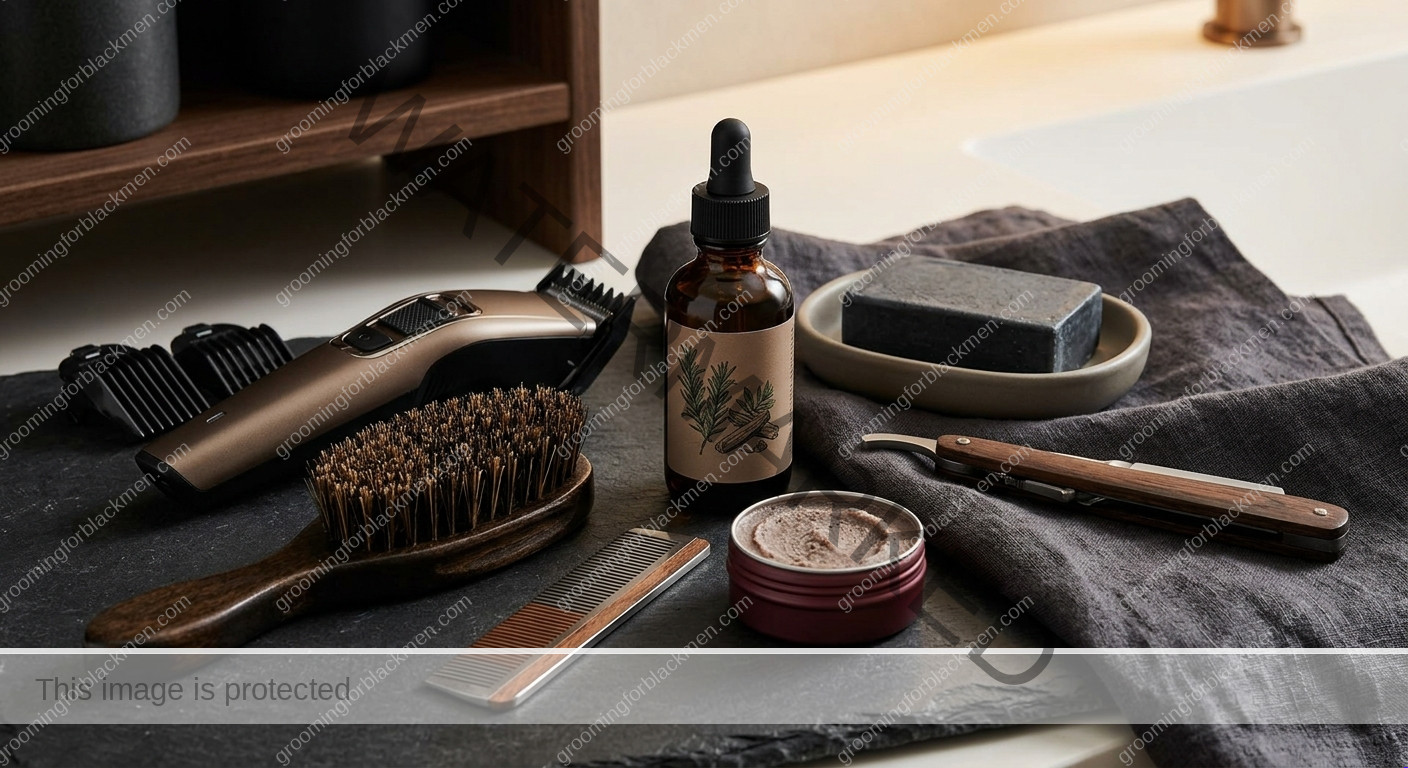
Buy only for a task you can name. A tool might make an agreed outline easier to maintain or replace something that tugs. It does not need to be described as a patch-filling solution to be useful. Keep the product decision smaller than the style decision.
As an affiliate site, GFBM may earn from qualifying purchases through product links. These optional searches are comparison starting points, not a tested shortlist or a recommendation to buy a complete kit.
A brush should make handling easier
If brushing is part of your usual routine, look for manageable size, comfortable handling, and a surface that does not scratch or snag. Do not assume a firmer brush will persuade a sparse area to grow. Consider whether a comb you already own performs the task well enough before adding another tool.
Browse beard brushes for Black men on Amazon. Check each listing’s construction, care instructions, and size. “For Black men” in a search phrase is not independent evidence that a particular brush suits your hair or skin.
Oil is optional, not an answer to missing coverage
If oil already works comfortably in your routine, judge it on handling and the finish you prefer. Do not add it simply because a sparse area is visible. Nor does a heavier application prove you are taking better care of your beard.
Browse beard oils for Black men on Amazon. Read the exact formula and directions rather than buying around a growth promise. If you are choosing a finishing product instead, our balm-versus-butter buying guide helps you compare that separate decision without automatically layering several products.
A trimmer should fit a task you understand
Prioritize clear instructions, attachments you can identify, a grip you can manage, and a cleaning routine you will follow. Check the manufacturer’s guidance for the actual model. A professional-looking tool does not make an unfamiliar technique safe or necessary.
Browse beard trimmers for Black men on Amazon. Before buying, decide what you will maintain yourself and what remains a barber task. If the tool is mainly an attempt to reproduce a complicated fade you have not learned, a simpler maintenance plan may be the better purchase decision.
Test the style against your actual week

A useful result has to work beyond the reveal photograph. Check whether you still like the outline when getting dressed, moving through a workday, or preparing for an event. These examples illustrate decisions, not guaranteed outcomes or before-and-after results.
If your cheeks are lighter but you like a fuller chin
Suppose the chin is the feature you want to retain. Begin the consultation with that instruction rather than asking for every area to match. Discuss whether shorter sides or a more compact outline would make the beard feel balanced to you while preserving the part you enjoy.
Afterward, notice whether the result makes sense from your usual viewing angles without repeated rearranging. If it does, visible cheek skin need not become a new problem to solve. If it does not, explain the specific shape issue at the next appointment instead of buying a growth product to answer a styling question.
If you need a quick morning routine
Choose the version you can manage with your actual time, including cleaning and putting tools away. A compact shape is not automatically quicker if you want its edges reset constantly. Ask the barber which parts of the finish can be left alone between visits.
If the new shape takes longer than you expected, decide whether the extra work is enjoyable or simply a burden. You can revise the plan without declaring the beard a failure. A practical style is one you understand how to wear, not one that demands an entirely different morning.
If there is an event coming up
Discuss the date and how much change you actually want. An event does not require a dramatic reduction, a new product combination, or a sharper boundary than you normally tolerate. A familiar shape with modest refinement may be closer to the brief.
Bring the same keep, change, avoid, and maintain notes. If you are trying something unfamiliar, explain that before the appointment is underway. Leave room for the barber to show options and for you to decline a change that would make you feel less like yourself.
When a change in growth needs a different kind of help
A new bare patch is not something this style plan can diagnose. The AAD explains that alopecia areata can involve the beard, but that is one possible explanation, not a conclusion to draw from a picture. A dermatologist can assess hair loss and discuss appropriate options.
If hair loss is new or changing, or there is pain, broken skin, or continuing irritation, seek professional advice rather than treating the area as a trimming problem. Record when you first noticed the change and which products or grooming changes preceded it. Do not delay assessment to finish a self-imposed growth challenge.
Frequently Asked Questions
1. Should I shave my beard off if the cheeks do not connect?
No single style is required. You can keep a sparse full outline, choose a shape centered on the chin and mustache, or prefer a shorter beard. Compare how each option fits your preferences and maintenance time. Before removing length, tell the barber what you want preserved and ask to see the proposed boundaries. Disconnected growth does not automatically make a beard unfinished. The useful choice is the one you want to wear, not the one that hides every difference.
2. Is there one beard length that makes patches less noticeable?
There is no universal length to prescribe from an article. Your current growth, curl pattern, preferred shape, and willingness to arrange it all affect the decision. A length that looks good in a reference picture may not create the same outline on you. Ask for a staged adjustment and review the overall result before further shortening. Keep a note of what was used if it helps future appointments, but do not assume another person’s guard number will reproduce their beard.
3. Can brushing or oil fill the gaps?
This guide does not establish a growth benefit for either. Judge a brush on comfortable handling and an oil on whether it suits your existing care routine. Changing the position or finish of hair is different from producing new hair. If a style needs constant brushing across one area, consider whether you enjoy that maintenance. You may prefer a different outline. Do not buy stronger brushes or more oil simply because you can still see the growth pattern beneath the style.
4. What should I tell a barber if I want to keep the chin?
Say it before cutting begins: “Keep this chin length; I want to discuss the sides, not shorten everything.” Then identify the change you want and any technique or product you wish to avoid. Ask the barber to show the intended boundary and pause after the first broad adjustment. You do not need technical terms to be clear. A short note and a reference to one specific feature can be more useful than asking for an entire photograph to be recreated.
5. Do both sides have to look exactly the same?
You can prefer a balanced overall outline without demanding identical density on both sides. Before trimming the fuller-looking side again, check whether the issue is the boundary, the arrangement, or the underlying growth pattern. Those are different things. If you are uncertain, save the question for a barber rather than repeatedly reducing the beard. Decide what looks good on your face at a normal viewing distance. Exact matching is not a requirement for a deliberate, well-maintained style.
6. Should I wait a fixed number of weeks before choosing a style?
This is not a timed growth challenge. You can discuss a workable style for the beard you have now and revisit it later if your preferences or growth change. Tell the barber whether preserving length matters so that today’s decision leaves the options you want. Do not promise yourself a particular connection or density by a deadline. If the concern is new hair loss rather than an established sparse pattern, arrange professional assessment instead of waiting for an arbitrary styling checkpoint.
7. How do I judge the result without constantly checking the mirror?
Pick a few ordinary criteria before the appointment: whether you like the outline, whether the routine fits your available time, and whether handling feels comfortable. Review those after a normal day rather than checking individual hairs throughout it. Write down one thing to keep and one thing to discuss next time. That gives the next appointment a useful starting point. You do not need daily progress photographs or public feedback to decide whether a style works for you.
What to do next
Choose one feature of your beard you want to keep, then one change that would make it easier to wear. Write both down before your next appointment. Add any product or technique you do not want and the amount of home maintenance you can realistically give the result.
Bring that brief to a barber and agree on the outline before cutting begins. Ask to review a broad adjustment before more length is removed. Leave with an explanation of what to maintain yourself and what to leave alone. That is a clearer plan than trying to make every sparse area disappear in one visit.
The broader patchy-beard overview is the category starting point; this page is the shape-and-maintenance companion. If the issue is recurring discomfort instead, use our recurring beard-itch guide to organize that separate concern, with professional advice when needed.
A successful appointment does not have to leave you with a denser-looking beard. It can leave you with a shape you chose, boundaries you understand, and less uncertainty about what to do in the morning. Your beard can look intentional while still showing its natural pattern.